
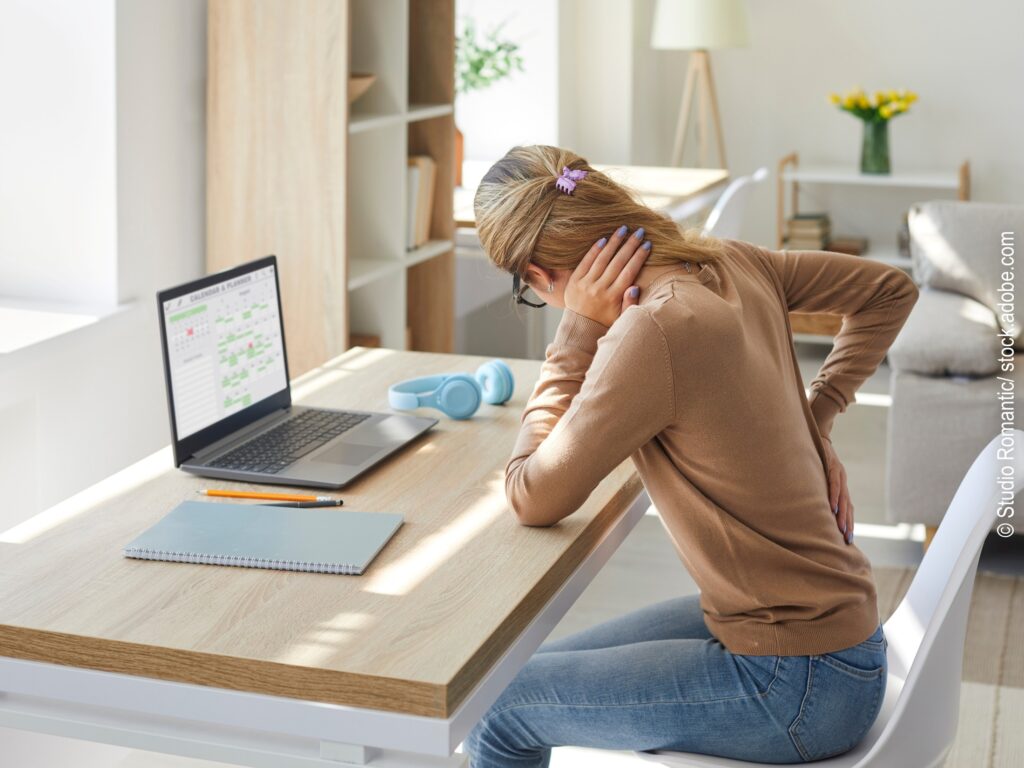
When the back fails, there is more silence than a workplace...
Sickness absence rates are slightly decreasing; is that a reason for some relief? Only to a limited extent. Because a comparatively small proportion of illnesses account for a large proportion of sick leave: illnesses that last longer than six weeks account for more than 40 percent of all sick leave, according to WIdO. 1. Musculoskeletal disorders, which also include back pain, have played a major role for years. For human resources managers, this means organizing representation, rescheduling projects, and often incurring costs for weeks. The good news: It is here that early, low-threshold prevention can make a difference, in the literal sense.
„Neck pain is the leading single cause of health-related limitations worldwide."
— World Health Organization (WHO), Fact Sheet „Low back pain" (2023)
The sick leave rate is slightly decreasing, but long-term absences are keeping it high.
First the good news: The absence rates are slightly decreasing. AOK-insured employees were on average 23.3 days absent due to illness in 2025, compared to 23.9 days the year before; in the previous record year 2022, the figure was even 24.5 days. 1. At the Techniker Krankenkasse (TK), the value fell from 19.1 to 18.6 days per person acquiring the coverage. 3. The values of the health insurance companies cannot be directly compared with each other in this case.
The picture changes once you look at the duration of the illnesses. The Scientific Institute of the AOK (WIdO) attributes the steady increase in illnesses lasting more than six weeks to the high number: they account for over 40 percent of the total number of sick days. 1. The TK also emphasizes that long-term health problems such as back pain or mental illnesses are less common, but are significantly more serious due to their prolonged duration. 3.
Musculoskeletal diseases are among the perennial problems. In AOK Bayern, in 2025, with 20.3 percent, the majority of days of incapacity for work fell under this diagnosis group, followed by respiratory diseases (14.0 percent) and mental illnesses (12.0 percent). There they have been ranked first for years for the diagnosis groups with a long duration of illness. 4. The TK records 2.62 days of absence per person employed due to musculoskeletal disorders (2024: 2.71) 3, In its evaluation, the group ranks third among the disease groups. 5. The ranking differs depending on the health insurance company. It is indisputable that the musculoskeletal system is one of the biggest causes of absenteeism.
At the same time, the AOK analysis shows how closely the body and the psyche are interconnected: Mental illnesses account for the largest share of the increase in long-term illnesses, causing the longest periods of absence with an average of 28.5 days of absence per case. 1, 4. The WHO also points out that chronic pain can affect sleep and mood. 2. Globally, around 619 million people were affected by intercostal pain in 2020; by 2050, an increase to 843 million is expected. 2.
Why lack of movement and one-sided strain add to back problems
Crossed pain rarely has a clearly identifiable cause: In about 90 percent of those affected, no specific disease or structure can be identified as the trigger (nonspecific crossed pain). The WHO lists low physical activity, smoking, obesity, and high physical strain at work as risk factors. 2. Most acute complaints subside on their own, but in some of the affected people they become chronic. 2. So much of what burdens the back is therefore related to everyday life and working conditions, and that is exactly where companies can take action.
The study literature on prevention has been examined in a large review involving more than 30,000 participants. Exercise combined with education reduced the risk of a back pain episode by around 45 percent (risk ratio 0.55; medium quality evidence), exercise alone by around 35 percent (risk ratio 0.65; very low to low quality evidence). Back belts and footwear did not show a preventive effect. Whether training or ergonomic adjustments also prevent sick leave is unclear due to the low quality of the studies. 6. In addition, the protective effect waned over extended periods of time, which is why the researchers suspect that sustained protection also requires sustained movement. 6.
The WHO recommends 150 to 300 minutes of moderate-intensity exercise per week for adults (alternatively 75 to 150 minutes of high-intensity exercise), plus regular muscle-strengthening activities. In addition, sitting time should be reduced, even though the available data do not provide a fixed limit. 7. The WHO lists ergonomic adjustments at the workplace as one of several components to alleviate discomfort and prevent further episodes, alongside physical activity, healthy body weight, good sleep, and abstaining from tobacco. 2. Movement is therefore a priority; the design of the workplace is a meaningful addition.
Looking ahead early instead of reacting late: focus on posture, mobility, and workplace
Long-term setbacks rarely begin overnight. Most acute back problems subside, but in some people they persist. 2. Companies that look ahead early achieve employees before a problem becomes a failure. There are three approaches that can be combined well.
Make it visible. A follow-up check provides an objective snapshot: With the Medi Mouse®, body posture, mobility, and back stability are analyzed in three positions without radiation in around 15 minutes per person, including personal evaluation and recommendations from professional staff. The Functional Movement Screen complements the assessment of mobility and stability as a whole. Important to keep in mind: Such screenings are a snapshot and not a medical diagnosis. If persistent or radiating pain, numbness, or weakness persists, consultation with a physician is required. 2.
Bringing movement into everyday life. Since movement is the best proven component of prevention according to current research findings 6, It is worth keeping offers low-key: exercise classes, short breaks at work, digital formats for employees working from home.
Check the workplace. A workplace analysis shows where working conditions can be improved ergonomically. Even if the evidence for ergonomic measures is limited alone. 6, They are a useful component that the WHO explicitly mentions. 2.
The special advantage: All three components can be combined in a health day. The results provide the company with a basis for planning further measures specifically, instead of working with the “big stick”.
Keeping your team moving: Our solutions for a strong back
Company Move helps you to establish low-cost back health programs in your company:
- Back check with the Medi Mouse® – Computer-based, radiation-free spinal analysis, approximately 15 minutes per person. Body posture, mobility, and back stability are tested in three positions; in addition, a personal evaluation and recommendations are provided by professional staff.
- Functional Movement Screen – Analysis of mobility and stability, approximately 15 minutes per person.
- Exercise classes – Activation & Balancing – Activative and balancing exercise units, also available digitally.
- Workplace analysis – Ergonomic analysis to optimize your working conditions, approximately 20 minutes per person.
- Webinars, lectures, workshops – Digital formats on various health topics, including back health, ergonomics, and exercise.
- Thematic pagesBack health, ergonomics and movement – an overview of offers and impulses for the respective focus areas.
- Health days & modules – The framework within which back-up checks, movement and advisory services can be bundled.
Your development impulse: Change is a process
Change is a process: Why a strong back needs small habits
Exercise protects the back only as long as it remains part of everyday life: The researchers of the large review conclude that sustained protection requires sustained exercise. 6. That doesn't mean that everything has to be different from tomorrow onwards. New habits need repetition, and that there are days when it doesn't work is a normal learning process and not a sign of lack of discipline. What matters is to start small and stay with it.
Practice Impulse: The 2-Minute Movement Break
A simple routine for between two appointments or phone calls:
- Stand up, place your feet hip-width apart and slowly rotate your shoulders back five times.
- Extend your arms over your head, stand up, and breathe calmly while doing so.
- Wait for about 30 seconds, for example until you reach the window, or quietly march in place.
Please perform all movements only in a pain-free area. If you have acute symptoms or pre-existing conditions, you should seek medical advice beforehand. The movement break does not replace regular exercise; the WHO recommends additional sufficient exercise per week. 7, However, it is a good starting point for breaking up sitting time.
Conclusion
The sick leave rate is slightly decreasing, but prolonged absences keep it high, and musculoskeletal problems play a central role in this. For companies, this presents an opportunity: anyone who looks early on, makes posture and mobility visible, and brings movement into the workday creates the foundation for turning complaints into long-term absences. The research evidence suggests that focusing primarily on movement and considering the workplace as a meaningful addition is essential.
Do you want to specifically strengthen the back of your team? Contact us, Together, we plan a health day with a follow-up check, exercise offerings, and workplace analysis that suits your company.
1 German Ärzteblatt. (2026, March 16). AOK: Slight decrease in sick days. Report on the analysis by the Scientific Institute of the AOK (WIdO). Accessed from https://www.aerzteblatt.de/news/aok-leichter-ruckgang-bei-krankheitstagen-cc6b6cd4-98e0-4de4-8460-d37f3cd83640
2 World Health Organization. (2023). Low back pain. Fact Sheet. Accessed from https://www.who.int/news-room/fact-sheets/detail/low-back-pain
3 Techniker Krankenkasse. (2026, January 27). TK Insured Persons: Slight decline in sick leave in 2026. Press release. Retrieved from https://www.tk.de/presse/themen/praevention/gesundheitsstudien/krankenstand-2026-2211552
4 AOK Bayern. (2026, March 16). AOK Bayern: Sick leave in 2025 slightly down. Press release. Retrieved from https://www.aok.de/pp/bayern/pm/default-bf1a820ca3/
5 Techniker Krankenkasse. (2026). Health report 2026 – Summary of leave absences. Retrieved from https://www.tk.de/resource/blob/2214302/9c99dbb2cea6422e50c6009c50e57e37/gesundheitsreport-au-2026-data.pdf
6 Steffens, D., Maher, C. G., Pereira, L. S. M., Stevens, M. L., Oliveira, V. C., Chapple, M., Teixeira-Salmela, L. F., & Hancock, M. J. (2016). Prevention of low back pain: A systematic review and meta-analysis. JAMA Internal Medicine, 176(2), 199–208.
7 Bull, F. C., Al-Ansari, S. S., Biddle, S., Borodulin, K., Buman, M. P., Cardon, G., et al. (2020). World Health Organization 2020 guidelines on physical activity and sedentary behaviour. British Journal of Sports Medicine, 54(24), 1451–1462. https://doi.org/10.1136/bjsports-2020-102955