
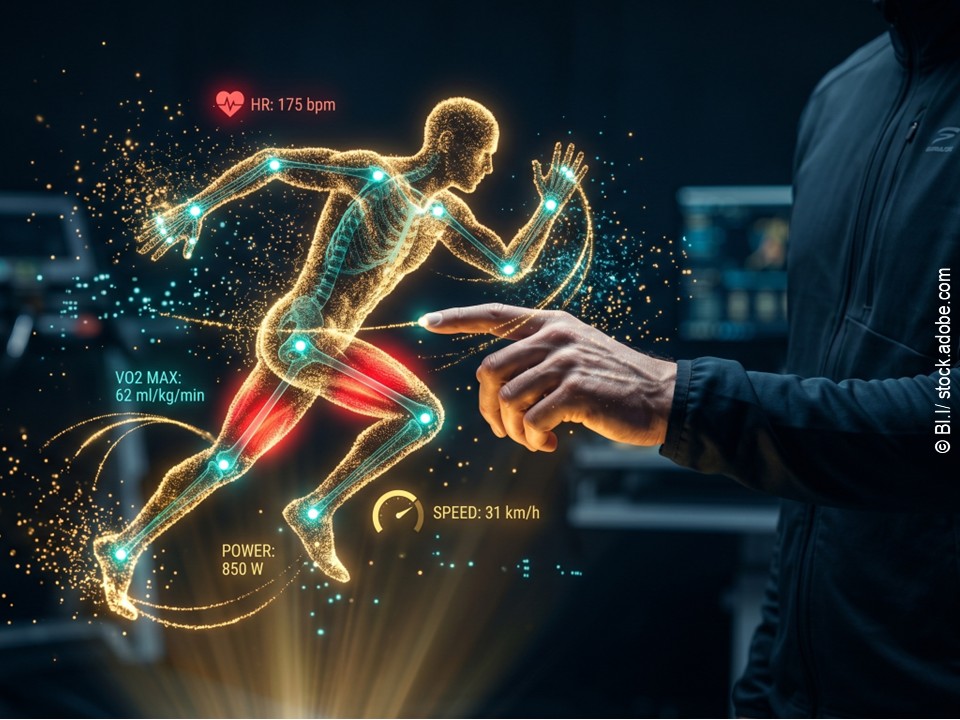
This number says more about your life expectancy than your cholesterol level – do you know your VO₂ max?
Most executives know their blood pressure, their cholesterol levels, and perhaps even their blood sugar. However, the value that current research links most closely to heart health and life expectancy often goes unnoticed: VO₂max. For a long time, it was considered a key performance indicator for elite athletes – a metric for marathon runners and professional cyclists, not for everyday work life. This notion is too limited. VO₂max is a central health indicator for everyone, regardless of their training status, and it can be actively influenced. Those who know and train their VO₂max are directly investing in their health and their years of life.
„In endurance sports, VO₂max is the most important parameter. It describes the maximum amount of oxygen that a person can take in, transport, and utilize under exertion.
— Prof. Dr. Ingo Froböse, Sports Scientist and Head of the Center for Health through Sport and Exercise, German Sport University Cologne
Why Most Leaders Don't Know Their Strongest Health Metric
VO₂ max, or maximal oxygen uptake, reflects how effectively the heart, circulatory system, lungs, and muscles work together. The more blood the heart pumps through the body per minute, the more oxygen can be absorbed from the air and transported to the working muscles. Thus, VO₂ max is a reliable indicator of a person's cardiorespiratory fitness and their aerobic endurance potential.
What makes this value particularly relevant for companies: A comprehensive meta-analysis by Kodama and colleagues, published in the JAMA journal, examined the link between cardiorespiratory fitness and the risk of coronary heart disease as well as all-cause mortality in healthy adults. The result: Individuals with low fitness have a significantly higher risk of premature death or developing cardiovascular disease than those with high cardiorespiratory fitness.1 These numbers show: VO₂max is not just a value for sports – it is an early indicator of the health of an entire workforce.
What Science Shows About Oxygen Uptake and Heart Health
From a scientific perspective, VO₂max is the result of a finely tuned system: the oxygen-absorbing, transporting, and utilizing organs. Studies demonstrate a close inverse correlation between VO₂max and cardiovascular morbidity and mortality – the higher the value, the lower the risk of developing or dying from cardiovascular disease.
Long-term studies also support this connection: a Finnish cohort study by Laukkanen and colleagues, published in Mayo Clinic Proceedings, emphasized the importance of maintaining stable cardiorespiratory fitness for decades on mortality in older age.2 VO₂ max is largely determined individually: body mass, muscle mass, age, sex, and training status are among the most important influencing factors. On average, women have a VO₂ max that is about 10 to 15 percent lower than men's, and people who regularly train endurance achieve significantly higher values than untrained individuals.
From the elite sports myth to a longevity tool for everyone
The crucial difference from the widespread myth: VO₂max is not only measurable, it is also trainable – and to a considerable extent. Trainability is around 20 to 50 percent. Those who train in the submaximal to high-intensity range, for example between 65 and 90 percent of their own VO₂max, can specifically increase their maximum oxygen uptake.
This makes it clear: VO₂max is not an exclusive value for athletes, but a central building block for longevity – for a longer, healthier, and more capable life. The American Heart Association even recommends in a scientific statement that cardiorespiratory fitness be routinely recorded as a clinical vital sign, on par with blood pressure or cholesterol.3 Those who bear responsibility in their professional lives benefit twice over: physically, through a more resilient cardiovascular system, and mentally, through more energy and concentration in daily work. The good news: Unlike many genetically determined health factors, VO₂max can be actively and positively influenced through targeted, regular training.
Our solutions for increased endurance and heart health in the workplace.
You want to do more than just discuss your employees' VO₂ max – you want to measure it. The problem with traditional testing methods: a precise VO₂ max determination has usually involved an exhausting performance test – with a treadmill, ergometer, and breathing mask. This is highly impractical for day-to-day business operations: time-consuming, strenuous, and a real deterrent for many employees.
With the SeismoFit This hurdle is eliminated by the Danish MedTech company VentriJect. The small, box-sized measuring device is simply attached to the lower chest area for about 40 seconds – the measurement is taken while lying down, without any physical exertion. Using highly sensitive sensors, the device captures the finest mechanical vibrations of the heart (seismocardiography) and, with the help of an AI-powered algorithm combined with height, weight, age, and gender, calculates a precise VO₂max value. Scientific validation studies have shown this method to be comparably accurate to the classic stress test.
For your company, this means: A VO₂max measurement that can take place in just a few minutes during working hours – without sweat, without equipment, and without employees having to exert themselves physically. Especially people who are less active or uncertain about sports get an easily accessible, comfortable introduction to their personal health metric. This transforms VO₂max from an abstract laboratory value into an everyday component of your corporate health management.
Your development impulse: Change is a process
Those who haven't paid much attention to their own endurance over the years won't increase their VO₂max overnight. This isn't a setback, but a normal learning process: the body needs time to adapt to new training stimuli, and unconscious movement patterns also only change through repetition. What's crucial isn't the pace of change, but the consistency with which the first step is taken.
Practice Tip: The Simple Gait Interval Check
A low-threshold entry to get a feel for your own endurance, entirely without a lab or testing equipment:
- Walk briskly for 3 minutes (you should still be able to hold a conversation, but breathing noticeably faster).
- Next, walk for 2 minutes at a normal pace to recover.
- Repeat this change 4 to 5 times.
Simply pay attention to how quickly your breathing returns to normal during the recovery phases. If recovery speeds up over time, it's a good sign that your endurance is already improving.
Conclusion
VO₂max is far more than just a number on a sports watch screen. It is a scientifically based indicator of cardiovascular health, performance, and longevity – and it can be actively trained. Knowing this value for yourself and your team means knowing one of the most effective levers for sustainable health within a company.
Do you know your number? Have your VO₂max professionally measured now and start your individual training program with a clear baseline. Contact us for a no-obligation consultation.
1 Kodama, S., Saito, K., Tanaka, S., Maki, M., Yachi, Y., Asumi, M., Sugawara, A., Totsuka, K., Shimano, H., Ohashi, Y., Yamada, N., & Sone, H. (2009). Cardiorespiratory fitness as a quantitative predictor of all-cause mortality and cardiovascular events in healthy men and women: A meta-analysis. JAMA, 301(19), 2024–2035. https://doi.org/10.1001/jama.2009.681
2 Laukkanen, J. A., Zaccardi, F., Khan, H., Kurl, S., Jae, S. Y., & Rauramaa, R. (2016). Long-term change in cardiorespiratory fitness and all-cause mortality. Mayo Clinic Proceedings, 91(9), 1183–1188.
3 Ross, R., Blair, S. N., Arena, R., Church, T. S., Després, J.-P., Franklin, B. A., … Wisløff, U. (2016). Importance of assessing cardiorespiratory fitness in clinical practice: A case for fitness as a clinical vital sign. A scientific statement from the American Heart Association. Circulation, 134(24), e653–e699.
4 Froböse, I. (personal communication/interview). Beat Yesterday – Asking Questions: What are performance tests good for?